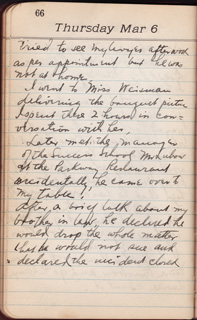
Thursday Mar 6

Tried to see my lawyer after work
as per appointment but he was
not at home

I went to Miss Weisman
delivering the banquet picture
I spent there 2 hours in con-
versation with her,

Later me the manager
of the Success School Mr. Lubow
at the Parkway Restaurant
accidentally, he came over to
my table!

After a brief talk about my
brother in law, he declared he
would drop the whole matter
that he would not sue and
declared the incident closed

————–

Matt’s Notes

So, here ends our subplot about the dastardly Mr. Lebow — head of the Success School and the very man about whom Papa tried to see his lawyer earlier in the day — and his mistreatment of Papa’s brother-in-law, Phil. Since I have trampled on his memory already, I’ll keep it going and assume he only dropped the matter of Phil’s tuition (remember, he kicked Phil out of school and tried to collect tuition anyway) because he was drunk, fresh from a visit to an opium den, or feeling flush because he had just burglarized an apartment.

He couldn’t have been all bad, though, because he knew where to go for good chopped liver. The Parkway Restaurant, where he ran into Papa, must have been the very Allen Street Roumanian schmalzateria Calvin Trillin pines for in the “Mao and Me” chapter of The Tummy Trilogy. Like Sammy’s Roumanian Steakhouse, the only such restaurant I’ve ever been to, the Parkway is said to have had singing waiters and pitchers of chicken fat on every table, though I expect it didn’t strive for such novelty in 1924. Incidentally, the photo Papa brought to Miss Wiesman was from a banquet he attended with her at Greenberg’s Roumanian Casino. This means he ate Roumanian food at least twice in the span of two months, making his mere survival until spring something of a miracle1. Papa finds more ways to win my admiration every day.

Anyway: A trip out to Brooklyn to see his old flame, a happy ending to the Success School Saga, and a nice piece of chicken (or maybe a veal chop) at the Parkway. Not such a bad day for Papa.

————-

Additional notes:

1 – Quoth Trillin:

The standard line about Romanian-Jewish cooking is usually credited to Zero Mostel, a great fan of the Parkway: “It’s killed more Jews than Hitler.”

I hope to learn more when I get my hands on another Trillin article from 1974 in which he profiled the Parkway in more detail for the New Yorker. Perhaps it’ll reveal if the Parkway Restaurant and the Parkway Palace, which Papa referred to earlier, are one and the same.

————-

My mother writes:

I still wish I knew more about the elusive Miss Weisman. If she was an old flame and Papa took her to banquets and brought her pictures of their evenings together, why was she still Miss Weisman? Why not Eva or Sally or whatever her first name was? Such formality. Well, she couldn’t have been too smart if she didn’t see Papa’s worth and grab him for herself.
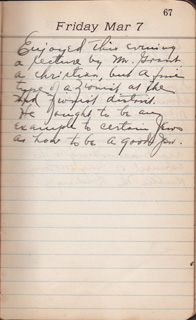
Friday Mar 7


Enjoyed this evening
a lecture by Mr. Grant
a christian, but a fine
type of a Zionist at the
2nd Zionist district.

He ought to be an
example to certain Jews
as how to be a good Jew.

————-

Matt’s Notes

I’m hardly qualified to comment on Chrisitan Zionism, though I’ve always understood it to be motivated more by biblical dictates than concern for the Jewish people. It’s certainly made for some strange bedfellows in the modern era; I wonder how a proto-lefty like Papa would have felt about the conservative ideals of today’s higher profile, evangelical Christian Zionists.

Sticky politics aside, I do find Papa’s language in this entry to be unusually strident. But, as we’ve seen before, Zionism and Judaism were simply one and the same for him and were essential to his spiritual identity. Jews who did not support a Jewish homeland baffled and disappointed him, and nothing made him happier than to see previously non-Zionist Jews throw their support behind the movement (we saw this in an earlier entry, when he attended a ceremony at which the United Hebrew Trades, after years of a strictly domestic agenda, officially announced its support for Jewish workers in Palestine).

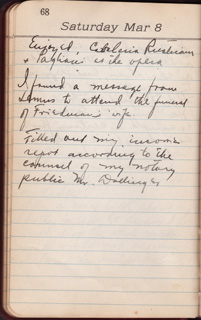
Saturday Mar 8


Enjoyed, Cabaleria Rusticany
and Pagliacci at the opera

I found a message from
Lemus to attend the funeral
of Friedman’s wife.

Filled out my income
report according to the
counsel of my notary
public Mr. Wallinger

————-

Matt’s Notes

Whenever possible I listen to the music, read the literature, and see the films Papa discusses in his diary, and recently I had the good fortune to see, at the Metropolitan Opera, the same double bill of Pagliacci and Cavalleria Rusticana Papa mentioned above. Until now any encounters I had with opera were purely accidental, the last one coming when I was a wee lad of 23 and then only because the words “free,” “ticket” and “girl” were involved. Though impressed with the players’ effort, I was generally distracted and came away feeling like I had missed the boat on opera appreciation.

So, to join the evening crowds at the Met — deliberately, with my own nice wife, and on my own power — and set down to pay attention was something I might never have done if I hadn’t started this diary project. And, as is always the case with the arts I experience on Papa’s “recommendation,” I found myself unexpectedly and powerfully absorbed by the proceedings. I was amazed, in general, because the things I saw and heard were the very things Papa saw and heard. This timelessness is, I suppose, an inherent quality of anything classical or traditional; even though Giovanni Martinelli sang Canio in 1924 and Salvatore Licitra sang him in 2007 (to raves from the New York Times) there’s a certain thrill to knowing Pagliacci has been essentially unchanged for generations.

But, there’s more to it than that; when I attended I was entirely awash in the sentimentality and melodrama of the work, and not just because Pagliacci and Cavalleria are so sentimental melodramatic. When I was a kid I used to pretend that Papa was hovering over my shoulder — in school, at home, when I was playing outside — hoping he was there to make sure everything came out all right. Maybe I still hope so; maybe that’s why I want to see the things Papa saw and do the things he did. It makes me I feel a little like we’re sitting side by side for a few hours, silently enjoying each other’s company. I know he would be beaming, smiling — fulfilled, entirely, just to be near me, to see me with my wife, to know I was alive. Under those circumstances, any song of love or loss or melancholy floating up from the stage becomes something else, the music for my own little opera, my duet with a ghost who I can’t touch or speak to but who means everything to me.

————————

Additional references for this post:

—————

Update 3/12

Mom adds about Papa’s love of opera:

I think Papa went very often, but was only able to afford standing room at that time. When I was growing up, he listened to the Met broadcast on radio, hosted by Milton Cross, every Saturday.

Sunday Mar 9


The unexpected happened
Brother Friedman’s wife
died suddenly, and it was
my sad duty as a brother
of one camp to attend the
funeral, which depressed
me.

I spent the evening at
Jack Zichlinsky’s house

—————-

Matt’s Notes

As noted earlier, Papa was an officer in a new chapter of the fraternal Order Sons of Zion (a.k.a. B’nai Zion) though this is the first time he referred to a fellow member as “Brother.” Papa usually called his friends like Jack Zichlinsky (he of Sheepshead Bay) by name even if they were B’nai Zion members, so I wonder if Papa wasn’t quite as close to Brother Freidman.

B’nai Zion functioned in part as a burial society (the rest of their charter included Zionist fund-raising, teaching Hebrew and providing life insurance) so maybe Papa went to Mrs. Freidman’s funeral more out of official, “sad duty” than out of pure friendship. Jews require a minyan — a group of ten or more men — to say kaddish (the prayer for the dead) at a funeral. I expect B’nai Zion guaranteed such a quorum for the families of all its members, which may be the duty Papa refers to here.

Speaking of which, Papa noted the day before that he “found a message from Lemus” asking him to attend the funeral. This brings up a lot of little questions: How, exactly, did he find this note? Did Lemus slip it under Papa’s door? Did he stick it in a mailbox? And who was Lemus? Was he an elected officer of Papa’s B’nai Zion chapter charged with distributing notes under such circumstances? Was he the superintendent of Papa’s building? Did people like Papa, who didn’t have a phone at this time, typically communicate by dropping notes at their friends’ and neighbors’ apartments?

Must…learn…more…

Monday Mar 10

Sister night & Movies
& home & radio

—————–

Matt’s Notes

Movies Papa might have seen that night include:

And here’s Papa listening to the radio at home:

Tuesday Mar 11

Visited brother Friedman
with brother Stern

This was a terrible weather
night, deep slush rain
and snow a biting wind.

———————–

Matt’s Notes

A bad night to be out visiting, indeed. Temperatures were just above freezing and New York had gotten over an inch of precipitation, half of which was rain and half snow. Plus, “the worst gale in 20 years,” according to the Times, hit the East Coast that day, delaying the arrival of the Aquitania in New York and resulting in the deaths of several people (two were hit by cars when their umbrellas obscured their views of oncoming traffic, one slipped and fell under a freight train, and one was killed by a toppled billboard).

Of course, “Brother Freidman” (so called because he was a member of Papa’s fraternal order Sons of Zion) probably wasn’t too concerned with the weather, as he was as in mourning for his wife who had died less than a week ago. Papa, and presumably “brother Stern,” had attended her funeral two days earlier, and were now paying a shiva call. According to Jewish tradition, Brother Freidman would have been unshaven, seated on a box to deny himself comfort, and wearing torn clothing. All the mirrors in his apartment would have been covered to relieve him of vanity, and his rooms were likely filled with friends and family, his table set with food brought by visitors to make sure he could focus on mourning.

Papa had found himself depressed at the funeral, and probably felt even more out of sorts at the shiva call. He idealized marriage and desperately wanted to experience it for himself. Under other circumstances, a married friend’s home might have filled him with quiet longing. But what about now? Brother Freidman had already known, and already lost, exactly what Papa wanted for himself. Where did such a jarring variation fit into Papa’s view of domestic life? Did he think, on this bleak and miserable March night, that he would have preferred even the pain of lost companionship to his own unending loneliness? Would he have traded places with Brother Freidman?

———————

Additional references

Wednesday Mar 12


Attended massmeeting
at the Hotel Astor marking
the opening of the 1924
$1,500,000 Keren Haysod
drive in NYC

Gladly I listened to the
speeches of the baalei teshuva
Dr. Silverman (Rabbi) and
Mr. David A. Brown.

All the enstranged Jews
are bound to come back
sooner or later.

Light must triumph over darkness.

————–

Matt’s Notes

This entry contains the Hebrew phrase baalei teshuva (the plural form of baal teshuva) which refers to Jews who have strayed from Judaism and returned to the fold.

In this case, Papa adapted the phrase to describe Jews who rejected Zionism and later came to accept it, specifically Rabbi Silverman and David Brown. Silverman was the Rabbi Emeritus of Temple Emanu-El, an influential Reform (or progressive) synagogue in New York, and for many years he had spoken out against Zionism. As reported in the Times, he returned from a trip to Palestine with a different point of view, and his speech at the Astor marked his commitment to “devote the remainder of his life to the cause of Palestine.”

As Papa crowded in with the other 1,000 attendees at the ball, he would have smiled to hear Silverman say:

Any Jew who willfully hinders the movement to rebuild the Jewish homeland is injuring his people and his faith. Any Jew who remains aloof from the movement at this critical period in our history lays himself open to the charge of indifference to the fate of a large part of Israel.

Papa has indicated his disapproval of non-Zionist Jews before (I’d almost say he held them in contempt, but I’m not sure he was capable of such feelings) but he has also indicated his willingness to rejoice in their “repentance.” My mother says he “never held a grudge in his life,” and after reading this entry I wonder if his capacity to forgive, to expect, in fact, people to turn themselves around, had spiritual roots in the concept of baal teshuva.

(Thanks to my wife, Stephanie, for the Hebrew lesson.)

———————-

My father, Sy Unger, died eleven years ago today. Here he is, around 1960, seated between Papa and my mother. How would Papa have told me to remember him?