 Simchas Torah
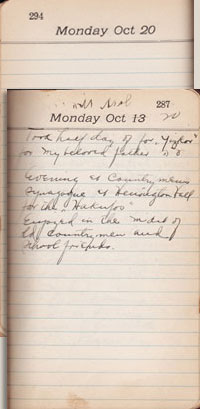
Took half day off for “Yizkor”
for my beloved father (olam haba)
Evening at Country mens
synagogue at Henington Hall
for the “Hakufos”
Enjoyed in the midst of
old country men and
school friends.
——————
Matt’s Notes
Non-observant Jews like me think of Yizkor, or the memorial prayer service, as a once-a-year occurrence associated with Yom Kippur. As I’ve recently learned, though, there are in fact four Yizkor services on the Hebrew calendar, and the one Papa mentions in this entry always takes place thirteen days after Yom Kippur as part of the agricultural festival Succot.
Holidays and milestones have given Papa trouble all year because they force him to take stock of his life and invariably lead to feelings of great loss and longing — not just for his father, who died back in May, but for everything he left behind in the old country. I would therefore expect him to write something mournful, or perhaps lapse into a contemplative silence, on this day of Yizkor. But, it also happened to be Simchas Torah, a joyful holiday in which observant Jews literally dance in the streets to celebrate the completion and re-opening of the annual cycle of Torah readings. While I have never participated in such a celebration myself, it cheers me to think of Papa crowding onto Second Street1 with his “old country men and school friends,” smiling and singing the songs of his youth and feeling, for at least a few hours, like New York was really his home.
—————
1 – Hennington Hall, located at 214 Second Street near Avenue B, was a meeting space often used for political gatherings and speeches. I think the “Country men’s synagogue” Papa refers to in this entry means Congregation Sniatyner Agudath Achim, which was made up of landsmen (the Yiddish term for people from the same place that literally translates as “country men”) from Papa’s home town of Sniatyn. I think this congregation normally met at a multi-use facility called Broadway Manor at 209 East Broadway, but I wouldn’t be surprised if they moved around a bit. In any event, Papa has never bothered to specify the congregation’s location before, so I assume he deliberately mentions Hennington Hall because it wasn’t their usual spot.
—————-
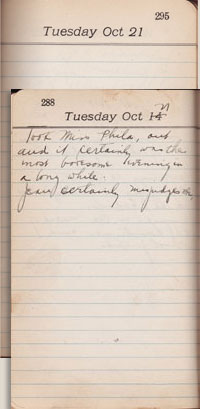
[Note: Papa accidentally wrote his October 20th entry on the October 13th page of his diary. I’ve included thumbnails of both pages at right.]
—————-
Update:
Here’s what Henington Hall looks like today (as discussed in a separate post).

——

——

——

——